Security & Compliance
Security Audit vs Penetration Test: What's the Difference

TL;DR
- A security audit asks "are the right controls in place." A penetration test asks "can someone actually break in, and how far." Different questions, and both matter.
- An audit looks at a lot of things at once: your rules, who can access what, whether software is kept up to date, and how systems are set up. It's checked against a known standard like CIS, NIST, SOC 2, or ISO 27001.
- A penetration test is different. Someone picks a few specific targets and actually tries to break in, the way a real hacker would, to see how far they can get.
- You can pass an audit and still be exploitable. You can also survive a pentest and still be missing basic controls an audit would have caught. Most companies eventually need both, not one instead of the other.
These two get used interchangeably in sales calls, and it causes real confusion. A prospect asks for "a security audit" and means a penetration test, or asks for "penetration testing" and actually needs someone to check whether MFA is enforced everywhere. They are not the same kind of project, they do not cost the same, and they do not answer the same question. Here's what each one actually is, and why most companies need both eventually, not one instead of the other.
What a security audit checks
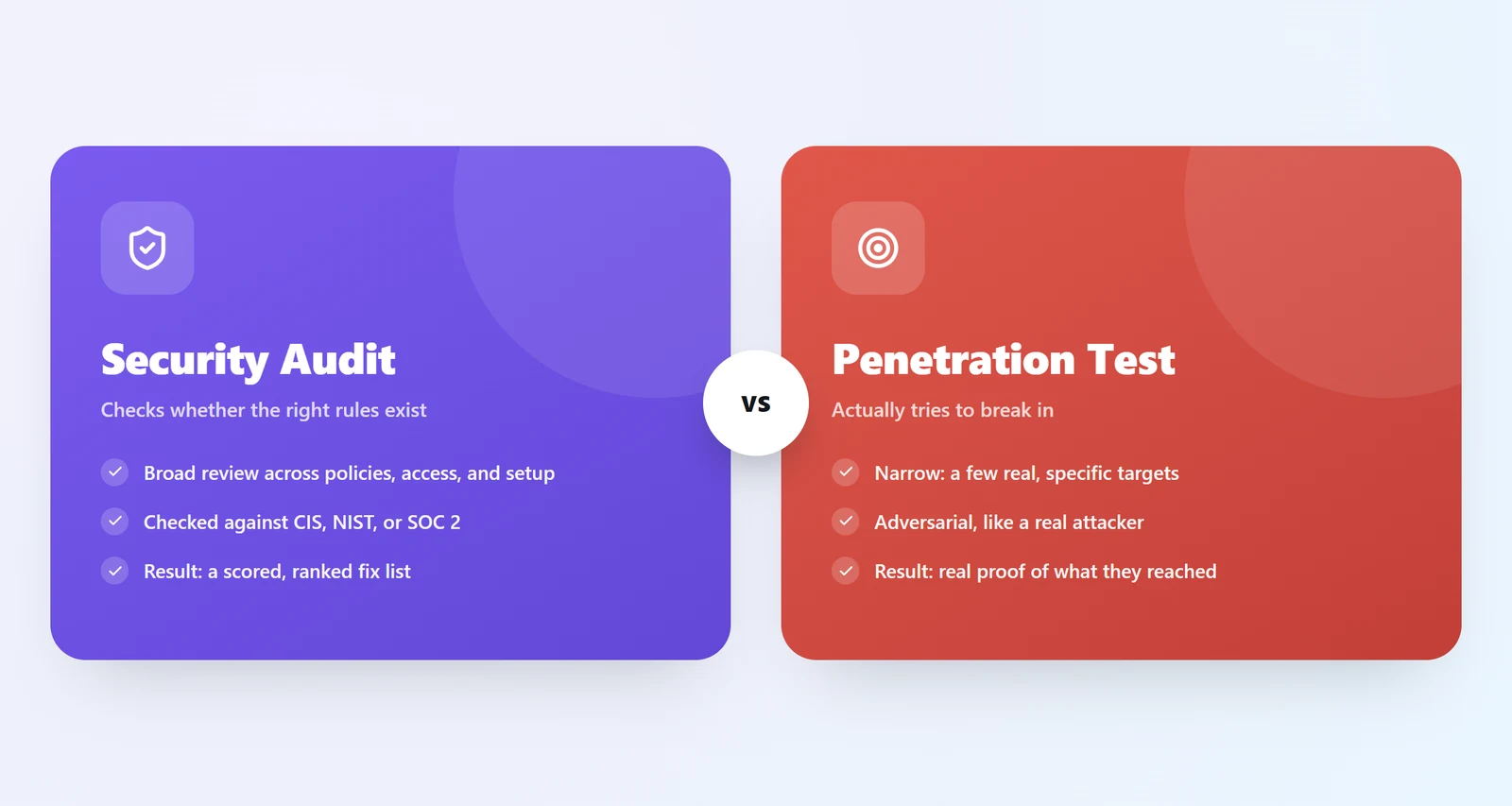
A security audit is a wide check of whether the right rules and protections actually exist, and are written down, not just something people assume is in place. Someone works through your policies, who has access to what, how your systems are set up, whether software is kept updated, and how your network is divided up so one problem can't spread everywhere. This is usually checked against a known standard, CIS Benchmarks, NIST, SOC 2, or ISO 27001. The result is a scored list: here's what's missing, here's what's set up wrong, here's what to fix first. Nobody is trying to break in during an audit. It's about checking whether the locks exist and are the right kind, not testing them by force.
This is close to what we do in a Security Audit engagement: a scored, prioritized review against CIS, NIST, and SOC 2, not a generic checklist, a list ordered by what actually matters first.
What a penetration test does
A penetration test works differently. Instead of checking everything, someone picks specific targets, your website, your app, or the tools your team uses to connect remotely, and actually tries to get in, the same way a real attacker would. The result isn't a checklist, it's real proof: here's the weak spot we found, here's how we got through it, here's how far we got once we were inside. A penetration test can only tell you about the parts it actually tried, which is why choosing the right targets matters so much. A test on too small a target can come back looking clean without actually meaning the rest of your systems are safe.
If you want to check some of this yourself first, ReconX is our free, open-source tool built for exactly that. It automatically scans for the most common ways websites and apps get broken into (known in the industry as the OWASP Top 10, a well-known list of the biggest risks). It won't fully replace a skilled human tester on a complicated system, but it catches a lot of the obvious problems before you ever pay someone to find them.
Side-by-side
| Security Audit | Penetration Test | |
|---|---|---|
| Question it answers | Are the right controls in place? | Can someone actually get in, and how far? |
| Scope | Broad: policies, access, configuration, patching | Narrow: specific systems you name upfront |
| Approach | Checking against a known standard | Actually trying to break in |
| Output | Scored gap report, prioritized fix list | Proof-of-concept exploit path, what was reached |
| Typical cadence | Annually, or after major infrastructure changes | Annually, or before a compliance deadline or major release |
When you need which
If you've never had either done, start with an audit. It's cheaper, wider-reaching, and it catches the basic gaps for free, gaps that would make a penetration test a waste of money if they're still open when the test starts.
Start with the audit
Cheaper and wider-reaching. It catches the basic gaps for free, before you pay someone to find them.
Fix what it finds
Close the basic gaps first, systems that were never updated, accounts with too much access, missing two-step login.
Then run the penetration test
Now it's actually testing something, not rediscovering things you already knew about.
Compliance rules tend to ask for both, on a regular schedule. SOC 2 relies heavily on proof that your rules are followed all the time, not just on the day of the check. PCI DSS goes further and requires a penetration test on top of that, done regularly. See our SOC 2 vs HIPAA vs PCI DSS post for how these rules differ on exactly this point.
Common mistakes
- Thinking a passed audit means nothing can be hacked. It doesn't. It only proves the written rules exist, not that every one of them would hold up in a real attack.
- Booking a penetration test before fixing what an audit would have caught for free. You end up paying a skilled tester to find things you already knew about.
- Never checking again after a fix. Without testing it again, nobody actually confirms the problem is really solved.
- Testing only a small part of your systems and missing the parts that matter. A clean report from a small test doesn't mean everything else is safe too.