Reliability & Operations
Should You Outsource On-Call? A DevOps Reality Check

TL;DR
- On-call burnout is one of the most common reasons senior engineers quietly start job hunting. It rarely shows up as a stated reason, but it's often the real one.
- 24x7 managed support means an outside team takes over the nights and weekends your own engineers currently split between themselves, with a real promised response time (called an SLA), not just a "we'll try our best."
- Companies that offer this commonly promise around 15 minutes to respond to the most serious problems. Don't just take that number on faith, ask them to prove it before you sign anything.
- The real decision usually isn't "in-house vs outsourced," it's a hybrid: outsource the 2am pages, keep ownership and architecture decisions in-house during business hours.
Every growing engineering team hits the same wall eventually: the people good enough to be trusted with production are also the people who get paged at 2am, and there's rarely more than three or four of them. Rotate that duty enough months in a row and you don't get better incident response, you get burnout, and eventually a resignation that has nothing to do with salary. Here's what outsourcing on-call actually looks like in practice, what it costs, and when it's worth it.
The real cost of on-call burnout
On-call burnout doesn't show up on a spreadsheet, which is exactly why it's easy to ignore until it's expensive. A senior engineer who's been getting paged at 2am for eighteen months doesn't usually file a complaint, they quietly start interviewing elsewhere, and replacing them costs far more than the pager duty ever saved. Smaller teams feel this hardest, a very different experience than a 50-person platform team where the same duty comes around once a quarter.
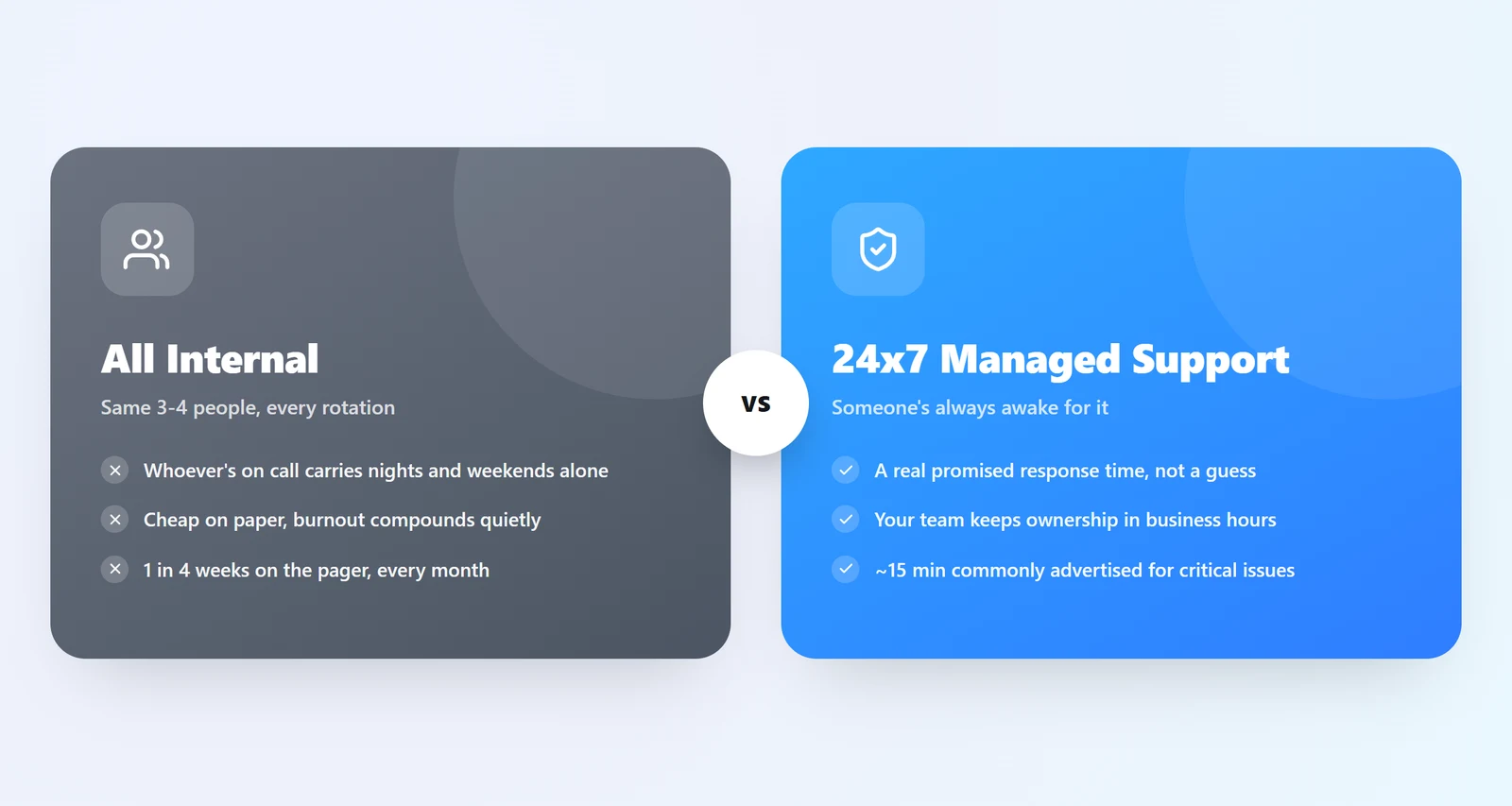
time for critical incidents
on-call at a small team
the pager, in that setup
What 24x7 managed support actually covers
"24x7 managed support" isn't one exact thing, it looks a little different with every provider, but the basic shape is usually the same: a dedicated team watches your systems around the clock, responds to problems with a promised response time (faster for serious problems, slower for small ones), and only pulls your team in when a real decision needs to be made that only you can make. Good providers also sit down with you after anything serious to go through what happened, instead of just closing a ticket with no explanation.
24/7 monitoring
Of the stack you already run, Prometheus, Grafana, Datadog, or CloudWatch, whatever it already is.
Faster response for bigger problems
A serious outage gets responded to faster than a small issue, based on a real, written promise.
Escalation, not silence
Your team gets pulled in only when a real decision only you can make is needed.
A real explanation afterward
After anything serious, not just a ticket closed with no explanation of what happened or why.
Build vs buy
| Keep it fully internal | Outsource on-call | |
|---|---|---|
| Nights & weekends | Whoever's on the rotation, if they wake up | SLA-backed response, someone's always awake for it |
| Team morale over time | Rotation fatigue compounds, quietly | Team keeps ownership, loses only the 2am pages |
| Cost | Looks free until someone burns out or quits | A predictable monthly line item |
| Institutional knowledge | Stays entirely in-house by default | Only stays intact with a real handoff, runbooks matter more, not less |
Almost nobody should pick one extreme. The teams that get this right usually keep ownership and architecture decisions in-house during business hours and outsource just the pager, nights, weekends, whatever coverage gap is actually causing the burnout. That's a much smaller, more specific ask than "run our entire infrastructure for us."
What to check before you sign
Ask for real response times
Their actual average and worst-case response time on a real past problem, not just the number on their marketing page.
Test the escalation path
Before you sign, not during your first real outage.
Dedicated team, or shared queue?
Confirm whether you get a real dedicated team, or get mixed into everyone else's ticket traffic.
What happens after an incident?
A real postmortem, or a ticket marked resolved with no explanation of what happened.
Common mistakes
- Outsourcing without writing real step-by-step instructions first. Without them, the outside team ends up guessing at 2am, the same way your own team was.
- Picking a provider on price alone. If you don't check their actual response time against a real past problem, the promise on paper doesn't mean much.
- Treating it as fire-and-forget. The value compounds when you review postmortems together and feed lessons back into your own systems.
- Never testing the escalation path until the first real outage. That's the worst possible time to find out it doesn't work.